





AI as a Launch-Readiness Lever
A Practical Framework for Peri-Launch Biotechs
Every peri-launch biotech faces the same pressure: small teams, fixed regulatory timelines, and the need to stand up commercial operations, field deployment, PRC (promotional review committee) workflows, medical affairs, and market access simultaneously. Everything happens at once, and the margin for error is razor-thin.
Into this environment walks the AI conversation. It is happening in every boardroom and on every investor call, and the dilemma it poses is sharper for peri-launch companies than for established actors: you cannot afford to ignore AI, and you really cannot afford to get it wrong.
Our thesis is simple:
AI should be treated as a launch-readiness lever, not a standalone transformation initiative.
Companies that embed the right AI tools into their commercial buildout from the start will launch faster, leaner, and with potential for an enhanced customer experience. The ones that chase AI without discipline will burn time and resources they do not have.
What’s Changed
Four shifts took place in the last twelve to eighteen months that make this conversation urgent.
First, tooling has matured beyond pilots. Enterprise productivity platforms and biopharma-specific solutions — e.g., PRC acceleration, knowledge synthesis, competitive tracking — are now commercially available and deployable. What were proof-of-concept experiments a year ago are now production-grade tools that a 50-person commercial team can adopt without building a data science function from scratch.
Second, the industry is all-in on AI — but execution is failing. Roughly 70% of pharma leaders (and 85% among the top 20 companies) now view AI as an immediate priority.1 Yet delivery is falling short of ambition: life sciences technology executives report inconsistent, hard-to-measure value from AI investments, with the biggest barriers sitting in execution — cultures, organizations and workflow transformation — rather than the technology itself.2 At the enterprise level, a widely cited MIT study found that 95% of generative AI pilots deliver little to no measurable P&L impact,3 and in pharma specifically, 68% of technology leaders say that neglecting data quality and governance early is the primary reason AI initiatives fail.4 The gap between ambition and execution is wide, and it is widest for companies with the least room for error.
Third, launch expectations remain high despite ongoing pressure on capital allocation. J.P. Morgan’s Q1 2026 data show first-time biotech financings on course for their lowest annual count since before the pandemic, with capital concentrating on de-risked assets and nearer-term catalysts.5 The first half of the year has continued in the same direction: J.P. Morgan’s healthcare bankers report that the IPO window has reopened for high-quality companies, blockbuster M&A is on pace to outstrip 2025, and investor selectivity remains far higher than during the pandemic-era boom.6 For peri-launch companies, the commercial buildout is when years of R&D investment begin to pay off, and it is also when investor scrutiny peaks. Shorter runways make every investment, including AI, a launch-readiness decision rather than an experiment.
Fourth, regulatory expectations around AI are forming now. In January 2025, the FDA issued two draft guidance documents on AI: a risk-based credibility assessment framework for AI in drug and biologics development, and a lifecycle management framework for AI-enabled devices.7 The EMA followed in March 2025 with its first qualification opinion on an AI-based clinical-trial methodology.8 In the EU, the AI Act’s high-risk obligations, just deferred to December 2027 under the Digital Omnibus, may capture some pharma AI applications.9 More immediately, the Act’s transparency obligations for AI systems, including labeling requirements for AI-generated content, still take effect in August 2026 on their original schedule. Operational AI for PRC and commercial workflows sits largely outside the high-risk regime, but the direction of travel is unambiguous. Building governance early is far easier than retrofitting once oversight catches up.
What’s at Stake
For peri-launch companies, the risks of getting AI wrong — or ignoring it entirely — are acute and compounding.
The first risk is wasted cycles on a fixed clock. Unlike large pharma organizations, peri-launch teams cannot absorb a failed six-month AI experiment. There is no slack in the system and no budget for learning experiences. Every misallocated initiative pulls people, attention and resources from launch-critical work at precisely the moment when focus matters most.
The second risk is building slow processes you will be stuck with. Peri-launch is when workflows get set. Standing up a manual-heavy PRC process or onboarding program now means retrofitting later, at greater cost and disruption, and likely during the very period when you need those processes to be running at peak efficiency.
The third risk is patient access delay. Faster content velocity, sharper commercial insight, and quicker field readiness all compress the time between approval and meaningful patient engagement. For rare and specialty conditions, that time matters enormously — not only for patients, but for the commercial trajectory of the product.
Each of these risks compounds into the same outcome: delayed product uptake. In a capital-constrained environment, slow uptake does not just affect quarterly numbers. It can reshape the long-term commercial trajectory of a product and the company behind it.
For peri-launch biotechs, the cost of getting AI wrong is not just wasted budget — it is lost time on a clock that does not reset.
A Practical Framework
Rather than an “AI strategy,” peri-launch companies need to think about AI through the lens of a launch-readiness framework — organizing around three pillars that channel AI investment toward outcomes that matter on an unforgiving timeline.
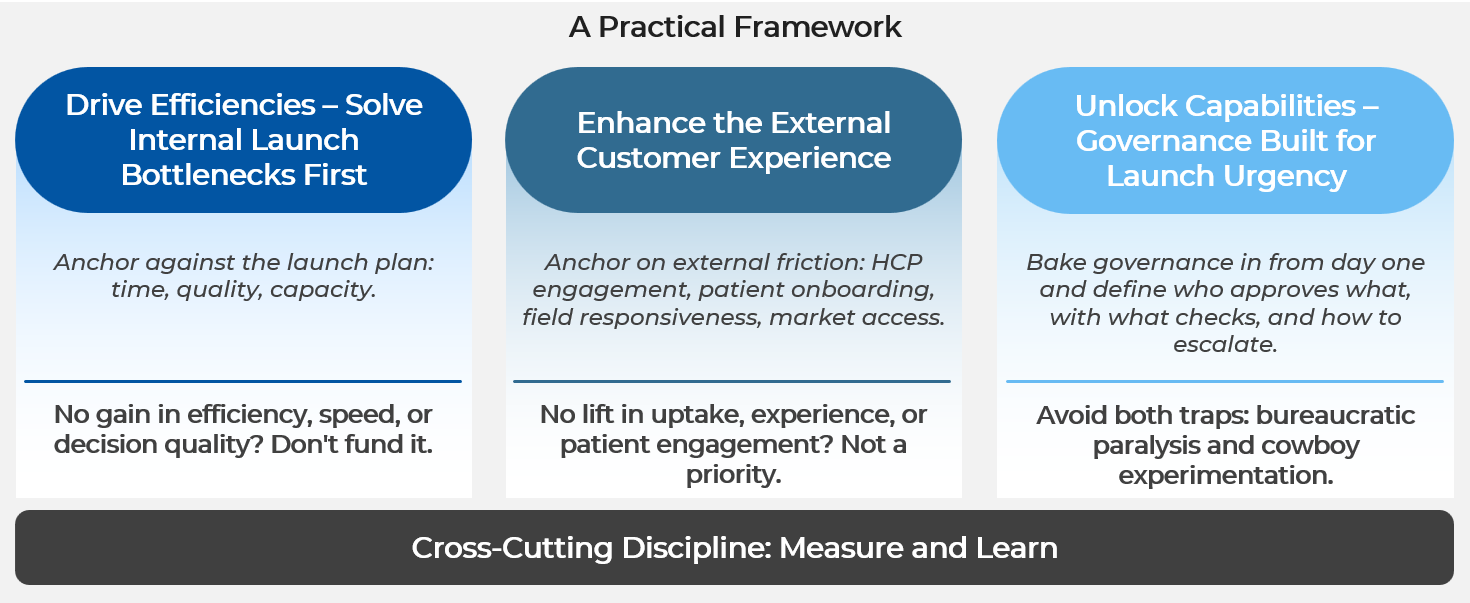
FIGURE 1: AI’s role in a practical launch-readiness framework
Pillar 1: Drive Efficiencies — Solve Internal Launch Bottlenecks First
The starting point is a focused internal problem audit against the launch plan. Where are the biggest time, quality, and capacity constraints? For most peri-launch companies, the highest-impact areas cluster around:
- PRC / MLR (medical, legal, and regulatory review) cycle acceleration
- Field onboarding ramp
- Advisory board and market research insight synthesis
- Competitive intelligence
These are not glamorous applications of AI, but they are the ones that free up hours, compress timelines, and improve decision quality where it matters most. To make that concrete: a PRC workflow where AI pre-screens draft materials against the approved claims library and prior review comments before submission does not replace reviewer judgment, but it can eliminate an entire review round. On a six-week cycle running dozens of assets ahead of launch, one round saved per asset is weeks of content velocity recovered at exactly the moment the field needs it.
The filter is straightforward: if a proposed AI investment does not improve efficiency, speed, or decision quality on the launch timeline, do not fund it.
Pillar 2: Enhance the External Customer Experience
Alongside the internal audit, companies should run a parallel external experience audit. Where are the friction points in HCP engagement, patient onboarding, field responsiveness, and market access? High-impact external use cases include:
- AI-driven HCP segmentation and engagement personalization
- Real-time field intelligence for representatives
- Patient support program optimization
- Payer and access analytics
The filter here is equally clear: if it does not improve product uptake, customer experience, or speed to meaningful patient engagement, it is not a launch priority. Importantly, the internal and external audits should inform each other.
The best AI investments often solve both: faster PRC turnaround directly translates to content reaching the field more quickly, which in turn drives better HCP and patient / caregiver engagement externally.
Pillar 3: Unlock Capabilities — Governance Built for Launch Urgency
Peri-launch companies have an underappreciated advantage: they are designing processes from scratch. That means they can build AI governance into workflows from the outset rather than bolting it on after the fact. The goal is a minimally viable governance model that enables capability unlocks by answering four questions:
- Who approves tools?
- What compliance checks are required?
- Who monitors outputs?
- And how do you escalate when AI touches promotional content or patient data?
The aim is to avoid both failure modes that derail AI adoption: bureaucratic paralysis, which kills launch momentum, and cowboy experimentation, which creates compliance risk at precisely the moment you can least afford it.
Cross-Cutting Discipline: Measure and Learn
Across all three pillars, measurement should be treated not as a separate initiative but as the connective tissue that validates or kills AI investments in real time. The metrics should be stated in launch-relevant terms: days removed from the PRC cycle, weeks compressed from the onboarding ramp, hours returned to the team per week, HCP engagement quality scores, and time-to-first-prescription metrics. Quick wins measured this way build internal credibility and operational muscle — both of which compound at launch and beyond.
The Opportunity
The goal is not to become an AI company. It is to launch sharper, faster, and leaner. Peri-launch is, paradoxically, the ideal moment to get this right. You are building from scratch, so build smart. Start with internal pain points and external experience gaps. Govern for launch speed, not perfection. Measure relentlessly and let the data tell you what to scale and what to stop.
AI is a launch-readiness lever. Fund it like one.
Asymmetry Group partners with peri-launch and emerging biotechs to turn commercial strategy into launch execution. Our work spans product strategy, launch excellence and execution, commercial operations, and organizational effectiveness — including the practical integration of AI into launch-readiness workflows. If your team is navigating these decisions, we would welcome the conversation.
References
[1] Fierce Pharma. (Jul 2025). AI is now an immediate priority for most big pharmas, and many plan to open their pockets further for AI. https://www.fiercepharma.com/marketing/ai-tech-immediate-priority-most-big-pharmas-many-plan-open-their-pockets-further-ai
[2] ZS / The Harris Poll. (Nov 2024). 2025 outlook: Life sciences leaders on data, digital and AI. https://www.zs.com/insights/2025-survey-data-digital-ai
[3] MIT NANDA / Fortune. (Aug 2025). “MIT report: 95% of generative AI pilots at companies are failing.” https://fortune.com/2025/08/18/mit-report-95-percent-generative-ai-pilots-at-companies-failing-cfo/
[4] ZS CDIO Research. (Nov 2025). https://www.zs.com/insights/scaling-ai-in-pharma-cdio-2026
[5] J.P. Morgan. Q1 2026 Biopharma Licensing and Venture Report. (Apr 2026). https://www.jpmorgan.com/content/dam/jpmorgan/documents/cb/insights/outlook/jpm-biopharma-deck-q1-2026.pdf
[6] CNBC. “Biotech IPO revival faces competition from cash-rich big pharma buyers.” (Jun 16, 2026), citing J.P. Morgan EMEA healthcare investment banking. https://www.cnbc.com/2026/06/16/biotech-deals-ipo-pharma-dealmaking-2026.html
[7] Federal Register. (Jan 7, 2025). Considerations for the Use of Artificial Intelligence To Support Regulatory Decision-Making for Drug and Biological Products. https://www.federalregister.gov/documents/2025/01/07/2024-31542/considerations-for-the-use-of-artificial-intelligence-to-support-regulatory-decision-making-for-drug; FDA CDRH, Artificial Intelligence-Enabled Device Software Functions: Lifecycle Management and Marketing Submission Recommendations, draft guidance. https://www.federalregister.gov/documents/2025/01/07/2024-31543/artificial-intelligence-enabled-device-software-functions-lifecycle-management-and-marketing
[8] European Medicines Agency. (Mar 2025). https://www.ema.europa.eu/en/news/ema-qualifies-first-artificial-intelligence-tool-diagnose-inflammatory-liver-disease-mash-biopsy-samples
[9] Digital Omnibus on AI, amending Regulation (EU) 2024/1689; Regulation (EU) 2026/1744 (Digital Omnibus on AI), amending Regulation (EU) 2024/1689; OJ 24 Jul 2026, in force 27 Jul 2026. High-risk obligations deferred to Dec 2, 2027 (Annex III) and Aug 2, 2028 (Annex I); Article 50 transparency obligations largely apply from Aug 2, 2026 as originally scheduled. https://www.consilium.europa.eu/en/press/press-releases/2026/05/07/artificial-intelligence-council-and-parliament-agree-to-simplify-and-streamline-rules/